💳 Payment Recovery ⏱ 18 min read Updated March 2026

The Complete Guide to
Dunning Management for SaaS

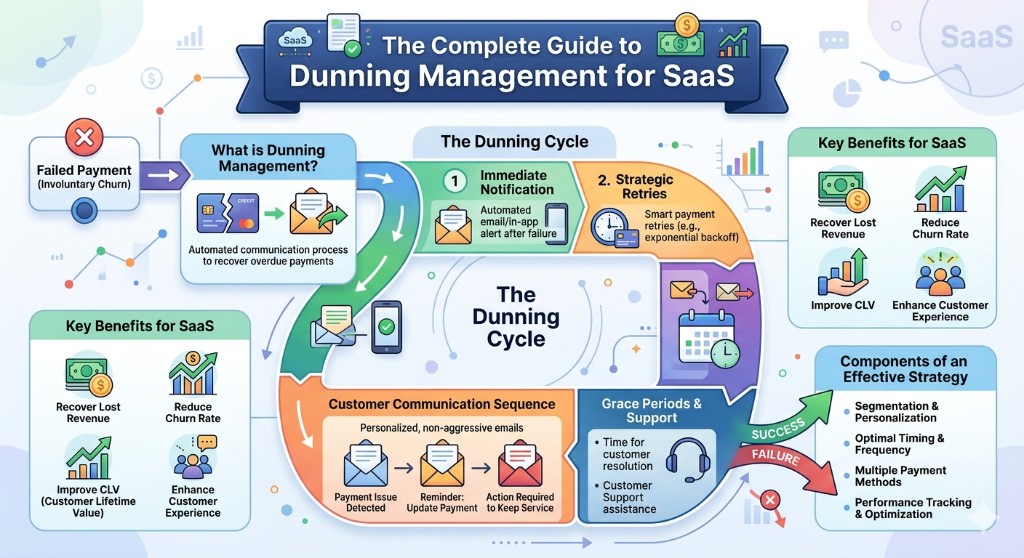
$129 billion is lost to payment failures annually — and up to 40% of your churn isn't voluntary. This guide covers every layer of dunning: why payments fail, the 3-phase lifecycle, soft vs hard declines, smart retries, the psychology of recovery, and how to integrate with Stripe or Chargebee.

Infographic: SaaS dunning management cycle—failed payment recovery, smart retries, customer communication, and revenue outcomes

⚡ TL;DR — Key Takeaways

  • The subscription industry loses $129 billion annually to payment failures — most of it preventable
  • Up to 40% of SaaS churn is involuntary: customers who wanted to stay but were lost to billing failures
  • 80–90% of payment failures are soft declines — temporary, retryable with the right timing
  • Single retry recovery: 23%. Intelligent multi-step dunning: 68–85%
  • Expired cards cause 42% of all payment failures — fully preventable with pre-dunning alerts
  • A complete dunning system has 3 phases: Pre-Dunning, Active Dunning, and Resolution & Escalation
  • Passive dunning (retries only) gets you ~23%. Active dunning gets you 70–85%
  • Recovered subscriptions continue for an average of 7 more months (Stripe, 2026)

What is Dunning Management?

Dunning management is the structured process of recovering failed subscription payments through automated retries, customer communication, and escalation sequences. The term "dunning" dates to 17th-century debt collection, but in modern SaaS it refers to a sophisticated retention system — not a collections department.

At its core, dunning management sits at the intersection of billing operations and customer success. When a customer's payment fails, they haven't decided to leave — their card expired, their bank blocked a transaction, or they hit a temporary limit. Dunning is the system that bridges that gap before it becomes permanent churn.

According to Maxio (2025), the best dunning systems combine empathy with automation: they treat every failed payment as a customer service event, not a collections event. The tone matters as much as the timing.

What Dunning Management Covers

Modern dunning management spans three layers that work together:

🔄

Smart Payment Retries

Retrying failed charges at optimal intervals based on decline codes — not blind fixed schedules.

📧

Email Recovery Sequences

Timed, empathetic email sequences that guide customers to update payment info without triggering churn.

🛡️

Pre-Dunning Prevention

Card expiration alerts and account updater services that prevent failures before they happen.

📊

Decline Code Intelligence

Reading the specific reason a payment failed and routing each case to the right recovery path.

⚖️

Escalation Logic

Knowing when to pause access, escalate to human support, and when to finally mark an account as lost.

🔗

Webhook Automation

Real-time event listeners that fire your recovery sequence the moment a payment fails.

$129BLost to payment failures globally in 2025
40%Of all SaaS churn is involuntary (failed payments)
85%Recovery rate achievable with AI-powered dunning
7 moAvg. additional subscription length after recovery (Stripe)

Why Payments Fail — And How Much It Costs You

Not all payment failures are equal. Understanding why a payment failed determines whether you should retry immediately, wait a week, or skip retries entirely and contact the customer. Misrouting a failure type is one of the biggest dunning mistakes SaaS companies make.

The 6 Most Common Payment Failure Reasons

Failure Reason% of FailuresTypeBest ResponseRetryable?
Expired card42%HardPre-dunning alert + card update email immediatelyNo — update first
Insufficient funds24%SoftRetry 3–5 days later (after payday cycle)Yes
Do Not Honor (generic bank block)15%SoftWait 5–7 days, then retry; email customer if second attempt failsYes
Lost or stolen card8%HardDo not retry — email customer immediately to add new cardNo
Card blocked / fraud flag6%MixedWait 7+ days; customer may need to contact their bankSometimes
Network / gateway timeout5%SoftRetry within 2–4 hours — likely a processing hiccupYes, quickly

What It Actually Costs Your Business

For a company at $10M ARR, involuntary churn from failed payments represents $130,000–$150,000 in preventable annual losses (Slicker HQ, 2025).

Lost subscription revenue (unrecovered)~60%
Customer acquisition cost wasted (CAC of lost customer)~25%
Support overhead (manual follow-ups, CS time)~10%
Brand damage (27% of declined customers switch competitor)~5%
⚠️

27% of subscribers cancel or switch competitors after a single payment decline

PYMNTS research (2025) shows that a payment failure isn't neutral — it actively damages your relationship with the customer. Every hour you wait before reaching out increases the chance they don't come back.

See how RetainFlow handles this automatically →

Involuntary Churn: The Revenue Leak Nobody Talks About

Voluntary churn gets all the attention — product teams obsess over it, CS teams build playbooks for it, executives track it in every board deck. But involuntary churn is larger, more preventable, and more often completely ignored.

Involuntary churn happens when a subscription lapses because of a payment failure, not a cancellation decision. The customer still wants your product. According to Dodo Payments (2026), 70% of involuntary churn originates from failed transactions rather than explicit cancellation decisions.

TypeCauseCustomer IntentPreventable?Primary Fix
Voluntary churnActive cancellationWants to leavePartiallyRetention flows, value delivery, cancel interviews
Involuntary churnFailed paymentWants to stayLargely yesDunning management — retries + emails

The Compounding MRR Effect

A single failed payment is a one-time event. But when multiplied across your subscriber base, even a 2% monthly payment failure rate against $500K MRR costs you $10,000 every single month — $120,000 a year — from customers who never intended to cancel. Each month you don't fix it, the hole gets bigger.

40%Of total SaaS churn stems from payment failures
$150KAvg. annual involuntary churn cost at $10M ARR
68%Recovery rate with intelligent multi-step dunning vs 23% with a single retry
Involuntary Churn — How Failed Payments Silently Drain SaaS MRR

Passive vs. Active Dunning

Most SaaS companies doing "dunning" are actually only doing passive dunning — automated retries with maybe one generic email. Active dunning is a multi-channel, psychology-informed system that treats each payment failure as a customer relationship event.

Passive Dunning

Set & Forget Retries

Relies on the payment processor to retry on a fixed schedule. No personalization, no decline code logic, no escalation.

  • Fixed retry schedule (e.g., day 3, 5, 7)
  • Generic "payment failed" email (if any)
  • No decline code differentiation
  • No customer segmentation
  • No escalation to support team
📉 Typical recovery rate: 20–30%
Active Dunning

Intelligent Recovery System

Reads decline codes, routes to the right retry strategy, fires personalized emails with one-click payment update links.

  • Decline-code-aware retry timing
  • 4-email personalized sequence with direct update links
  • Pre-dunning expiry alerts (before failure)
  • Customer segmentation by plan and LTV
  • Escalation to CS for high-value accounts
📈 Typical recovery rate: 60–85%

The difference in outcome isn't incremental — it's 3–4x. Churn Buster's 2026 benchmark data shows that companies moving from passive to active dunning see median recovery rates jump from 27% to 71% within 90 days of switching.

Soft vs. Hard Declines Explained

Every payment failure comes with a decline code — a signal from the card network or issuing bank that tells you exactly what went wrong. The single biggest mistake in dunning is treating all declines the same. Retrying a hard decline wastes attempts, damages your merchant standing, and delays the customer outreach that would actually fix the problem.

🟢 Soft Declines — Temporary

A soft decline means the issue is likely temporary and may resolve on its own, or with a retry at the right time. These make up 80–90% of all payment failures in B2B SaaS.

  • Insufficient funds (retry after payday)
  • Temporary bank hold
  • Network or gateway timeout
  • Generic "Do Not Honor" (bank's internal filters)
  • Credit limit exceeded
Response: Retry intelligently (3–5 day intervals). Send email only after 2nd retry fails.

🔴 Hard Declines — Permanent

Hard declines signal a permanent issue that cannot be resolved by retrying. Retrying a hard decline will not succeed and can harm your merchant standing.

  • Expired card
  • Lost or stolen card
  • Account closed
  • Card number invalid
  • Fraudulent — Do Not Honor (permanent)
Response: Do NOT retry. Trigger immediate customer email with one-click card update link.

Decline Code Reference

Stripe Decline CodeTypeRecommended Retry WindowEmail?
insufficient_fundsSoft3–5 days (post-payday)After 2nd failure
do_not_honorSoft5–7 daysAfter 2nd failure
card_declined (generic)Mixed24–48 hoursImmediately
expired_cardHardDo not retryImmediately
lost_cardHardDo not retryImmediately
processing_errorSoft2–4 hoursOnly if 3rd attempt fails

The Dunning Lifecycle: 3-Phase Structure

A production-grade dunning system is not a single email or a retry loop. It's a structured lifecycle with three distinct phases, each with its own goal, tools, and timing logic. Miss any one phase and your overall recovery rate drops significantly.

1

Pre-Dunning

Prevention · Days −30 to 0

Stop failures before they happen. The highest-ROI phase.

  • Card expiration alert at 30 days before expiry
  • Second alert at 7 days before expiry
  • Account Updater service (auto-refresh card data)
  • Annual billing reminders (7 and 3 days out)
  • Proactive "update your card" nudge in-app
2

Active Dunning

Recovery · Days 0 to 14

Execute the recovery sequence. Most revenue is won or lost here.

  • Immediate smart retry (decline-code-aware)
  • Email 1 within minutes: friendly, assume glitch
  • Smart retry 2 at day 3–5
  • Email 2 at day 3: gentle reminder + plan value
  • Email 3 at day 7: urgency + access deadline
  • Email 4 at day 12: final notice
3

Resolution & Escalation

Close-out · Day 14+

Decide the final outcome — recover, pause, or close gracefully.

  • Pause access (not delete) with 30-day grace period
  • Escalate high-LTV accounts to CS team
  • Offer downgrade or payment plan if needed
  • Trigger win-back sequence 30/60/90 days later
  • Tag for re-engagement campaigns
The 3-Phase Dunning Lifecycle: Pre-Dunning, Active Dunning, Resolution

Phase 1: Pre-Dunning (Prevention)

Pre-dunning is the most underused phase. Expired cards alone account for 42% of all payment failures, and every single one is preventable with a 30-day advance expiration alert. Account Updater services automatically refresh card details when a customer gets a new card — recovering up to 20–30% more invoices before a retry is even needed (Stripe Resources, 2026).

Phase 2: Active Dunning (The Recovery Sequence)

The active dunning window is typically 14 days. After 14 days, recovery rates drop sharply. The sequence should be: immediate retry → email 1 (friendly) → retry 2 → email 2 (reminder) → retry 3 → email 3 (urgency) → email 4 (final). Every email must contain a one-click payment update link that bypasses login — this single change typically lifts recovery by 15–20 percentage points.

Phase 3: Resolution & Escalation

When the active sequence ends unresolved, always pause — never delete. A paused account can be reactivated; a deleted account is gone forever. High-LTV accounts (top 20% by MRR) should be escalated to a human CS rep for personal outreach. A grace period of 30 days with in-app messaging often recovers an additional 8–12% of accounts.

Why Smart Retries Alone Are Not Enough

Smart retries are necessary. They are not sufficient. Many SaaS companies implement Stripe's Smart Retries or Chargebee's Smart Retry mode and call it "dunning." That's like calling a seatbelt a full car safety system.

🔁 Retries Only (No Emails)

23%

Recovery rate with single retry only

  • No customer awareness of the failure
  • Card issues require customer action — retries can't fix them
  • Retry limit hit → silent cancellation
  • Customer finds out when access disappears

⚡ Retries + Full Dunning System

68–85%

Recovery rate with complete dunning

  • Customer informed within minutes of failure
  • One-click update link removes friction
  • Multi-email sequence catches different intent states
  • Hard declines routed to human outreach

The math is stark. Moving from retries-only (23%) to a full dunning system (70%) on a base of 100 monthly failures at $100 ARPU means recovering an additional 47 customers per month — $56,400 per year from a one-time setup.

Smart retries solve the technical problem (should we try charging again?). Dunning emails solve the human problem (does the customer know there's an issue, and can they fix it easily?). You need both. According to Paraglide AI (2026), AI-led follow-ups that combine timing optimization with personalized messaging consistently outperform pure retry logic by 2–4x.

The Psychology Behind Successful Payment Recovery

The words in your dunning emails matter as much as the timing. Customers who receive threatening or transactional dunning emails are more likely to cancel voluntarily than to update their payment details. The psychology of recovery is about reducing friction, preserving dignity, and giving customers a clear path forward.

1

Assume it's a mistake, not negligence

Your first email should assume the customer didn't know their payment failed — because they probably didn't. "We couldn't process your payment" lands better than "Your payment is overdue." Frame it as a shared technical issue to fix together.

2

Loss aversion over gain framing

People are more motivated by the fear of losing something they have than by the prospect of gaining something new. "Your access to [feature] will pause on [date]" is more effective than "Keep enjoying [feature]." Use loss framing carefully and honestly.

3

Reduce friction to near-zero

Every click, every login required, every form field is a dropout point. Your email should contain a magic link that opens directly to a pre-filled payment update page. Customers who have to log in first convert at roughly half the rate (Maxio, 2025).

4

Gradual urgency escalation

Your sequence should escalate tone from friendly → informational → urgent → final. Jumping straight to urgent language triggers defensiveness. Starting too soft and staying soft is ignored.

5

Personalization signals care, not automation

Using the customer's first name, their plan name, and the specific feature they'll lose creates the psychological experience of an individual message — even if it's automated.

The Recovery Email Sequence Ladder

Webhooks for Failed Payments

Webhooks are the nerve system of your dunning infrastructure. They deliver real-time events from your payment processor to your application — meaning your recovery sequence fires within seconds of a failure, not the next morning when a cron job runs.

Without webhooks, you're polling for payment status or waiting for a daily batch job. With webhooks, you know about a failure the instant it happens and can begin the recovery sequence before the customer even notices.

Key Webhook Events to Listen For

invoice.payment_failed
The primary trigger. Fire immediately: log the failure, read the decline code, start retry logic, queue Email 1 for delivery within 15 minutes.
invoice.payment_succeeded
Payment recovered — cancel all pending dunning emails, restore full access, and optionally send a "you're all set" confirmation.
customer.subscription.deleted
Subscription cancelled. Trigger win-back sequence and tag for re-engagement.
payment_method.updated
Customer updated their card — cancel pending dunning emails, trigger a retry immediately if invoice is still unpaid.
invoice.upcoming
Upcoming invoice warning — use for pre-dunning alerts, especially for annual plans.

Stripe Webhook Implementation (Node.js)

webhook.js — Stripe failed payment handler
// Install: npm install stripe express
const stripe = require('stripe')(process.env.STRIPE_SECRET_KEY);
const express = require('express');
const app = express();

app.post('/webhook', express.raw({ type: 'application/json' }), async (req, res) => {
  const sig = req.headers['stripe-signature'];
  let event;
  try {
    event = stripe.webhooks.constructEvent(req.body, sig, process.env.STRIPE_WEBHOOK_SECRET);
  } catch (err) {
    return res.status(400).send(`Webhook Error: ${err.message}`);
  }

  switch (event.type) {
    case 'invoice.payment_failed': {
      const invoice = event.data.object;
      const declineCode = invoice.last_payment_error?.decline_code;
      const isHardDecline = ['expired_card', 'lost_card', 'stolen_card'].includes(declineCode);
      await startDunningSequence({ customerId: invoice.customer, invoiceId: invoice.id, declineCode, isHardDecline });
      break;
    }
    case 'invoice.payment_succeeded': {
      await cancelDunningSequence(event.data.object.customer);
      await restoreFullAccess(event.data.object.customer);
      break;
    }
    case 'payment_method.updated': {
      await retryOpenInvoices(event.data.object.customer);
      break;
    }
    case 'customer.subscription.deleted': {
      await startWinBackSequence(event.data.object.customer);
      break;
    }
  }
  res.json({ received: true });
});

Always verify webhook signatures before processing. Use idempotency keys to prevent duplicate actions on webhook retry.

Integrating with Stripe or Chargebee

Stripe and Chargebee are the two most common billing platforms for SaaS companies with active dunning needs. Stripe gives you primitives to build on; Chargebee gives you a more opinionated out-of-the-box system. Here's how they compare and what to wire up.

Stripe Billing API-first

Dunning approachSmart Retries + custom webhook logic
Built-in email dunningBasic — needs customization
Retry logicSmart Retries (ML-powered, up to 4 attempts)
Max retriesUp to 8 (configurable)
Card updaterAutomatic (Visa/MC updater built-in)
Best forFull control + custom email sequences

Chargebee Full-stack billing

Dunning approachBuilt-in dunning module with visual flow builder
Built-in email dunningYes — fully customizable templates
Retry logicSmart Retry mode — up to 12 attempts
Max retriesUp to 12 (Smart Retry mode)
Card updaterVia Stripe gateway integration
Best forOut-of-the-box dunning with less engineering

Key Integration Points (Both Platforms)

Integration PointWhy It MattersStripeChargebee
Webhook endpointReal-time failure alertsinvoice.payment_failedpayment_failed
Customer portal linkOne-click card updateStripe Customer PortalChargebee Self-Serve Portal
Account UpdaterAuto-refresh card dataEnabled by defaultVia Stripe gateway
Subscription pause APIPause vs delete on failurepause_collectionPause subscription endpoint
Idempotency keysPrevent duplicate chargesPass in header per requestBuilt into Smart Retry mode

📚 Sources & Citations

  1. Paraglide AI (2026). Dunning Software for B2B: Speeding Up Collections. Best practices for AI-led follow-ups. paraglide.ai
  2. Maxio (2025/2026). What is Dunning Management? Best Practices Guide. Focus on empathy-first communication. maxio.com
  3. Stripe Resources (2026). Automated Dunning Requirements and Tips. Smart Retries, webhooks, global billing. docs.stripe.com
  4. Churn Buster (2026). 8 Best Dunning Software Solutions. Performance benchmarks and recovery rate comparisons. churnbuster.io
  5. Slicker HQ (2025). How SaaS Companies Can Cut 2025's $129 Billion Involuntary-Churn Bill. slickerhq.com
  6. Dodo Payments (2026). Involuntary Churn: How Failed Payments Silently Kill SaaS Revenue. dodopayments.com
  7. PYMNTS Research (2025). Subscription commerce & churn. 27% of subscribers cancel or switch after a card decline.
  8. HighRadius (2026). Guide to Dunning Management. highradius.com
  9. Chargebee Documentation (2026). Dunning — Smart Retry Mode. chargebee.com/docs
  10. Quantledger (2025). Soft vs Hard Declines: Targeted Payment Recovery. quantledger.app

Frequently Asked Questions

Common questions about dunning management, payment recovery, and involuntary churn for SaaS businesses.

What is dunning management and how is it different from collections?

Dunning management is the automated process of recovering failed subscription payments through smart retries and personalized email sequences. It's fundamentally different from debt collections: dunning targets customers who want to stay subscribed but had an involuntary payment failure (expired card, insufficient funds, etc.). Dunning is a customer success function; collections is a legal/financial one.

How much revenue can a dunning system realistically recover?

A fully optimized dunning system recovers 60–85% of failed payments. Retries alone recover approximately 23% with a single attempt. Intelligent multi-step dunning (retries + personalized email sequence + pre-dunning prevention) lifts that to 68–85%. The key variables: how quickly you detect failures, whether you use decline-code-aware retry logic, and whether emails have one-click payment update links.

What is the difference between a soft decline and a hard decline?

A soft decline is temporary — insufficient funds, temporary bank holds, network timeouts — and can be resolved by retrying at the right time. A hard decline is permanent — expired, lost, or stolen card — and retrying will never succeed. The correct response to a hard decline is to immediately email the customer to update their payment method, not retry the charge. 80–90% of B2B SaaS payment failures are soft declines.

How long should a dunning sequence last?

Best practice is 14 days for the active dunning window, with a grace period of up to 30 days for account access. After 14 days, recovery rates drop significantly as customers mentally move on. After the active window closes, pause the account (don't delete it) and start a 30/60/90-day win-back email sequence.

What is involuntary churn and how is it different from voluntary churn?

Involuntary churn occurs when a subscription lapses due to a payment failure — the customer never decided to cancel. Voluntary churn is an active cancellation decision. Involuntary churn accounts for up to 40% of total SaaS churn and is largely preventable with proper dunning. These customers still want your product — you're just fixing a technical obstacle.

Should I retry immediately after a payment failure?

It depends entirely on the decline code. For network timeouts, retry within 2–4 hours. For insufficient funds, wait 3–5 days (after payday). For Do Not Honor, wait 5–7 days. For expired, lost, or stolen cards, do not retry at all — email the customer immediately instead.

Do I need webhooks to build a dunning system?

Yes — webhooks are essential for a real-time dunning system. Without them, you'd need to poll for payment status, causing delays of minutes to hours. Webhook-driven dunning fires Email 1 within 15 minutes of a failure. For Stripe, listen to invoice.payment_failed. Always verify webhook signatures before processing.

How many dunning emails should I send?

Four emails over 14 days is the industry benchmark: Email 1 at Day 0 (friendly notice), Email 2 at Day 3 (gentle reminder), Email 3 at Day 7 (urgency with access deadline), Email 4 at Day 12–14 (final notice). More than 4–5 emails generates unsubscribes. The highest-performing addition is a one-click payment update link in every email — this alone boosts recovery by 15–20 percentage points.

What is the ROI of setting up a dunning system?

For a company at $500K MRR with a 2% monthly payment failure rate, moving from retries-only (23%) to full dunning (70%) recovers an additional ~$5,700/month — $68,400/year from a one-time setup. The ROI compounds because recovered subscribers continue for an average of 7 additional months (Stripe, 2026).

Can I use RetainFlow if I'm already on Stripe or Chargebee?

Yes. RetainFlow integrates directly with Stripe and Chargebee via webhooks and API. It layers on top of your existing billing platform — no need to switch payment processors. Setup takes under 30 minutes and requires no engineering resources.

Stop Losing Revenue to Silent Churn

RetainFlow's dunning system handles every phase automatically — pre-dunning alerts, decline-code-aware retries, personalized email sequences, and Stripe/Chargebee integration in under 30 minutes.

5-day free trial · No credit card required · Works with Stripe & Chargebee